RF :: HAM Radio Propagation
High-frequency (HF) propagation refers to the way radio signals travel through the atmosphere at frequencies between approximately 3 and 30 MHz. Within this frequency range, the ionosphere plays a crucial role. This region of charged particles in the upper atmosphere can reflect and refract radio waves, significantly extending the range of a signal. As a result, a signal can travel beyond the horizon and even reach the opposite side of the Earth by means of multiple "bounces".
| Band | Day | Night |
|---|---|---|
| 10m-12m | Fair | Poor |
| 15m-17m | Fair | Fair |
| 20m-30m | Good | Good |
| 40m-80m | Poor | Fair |
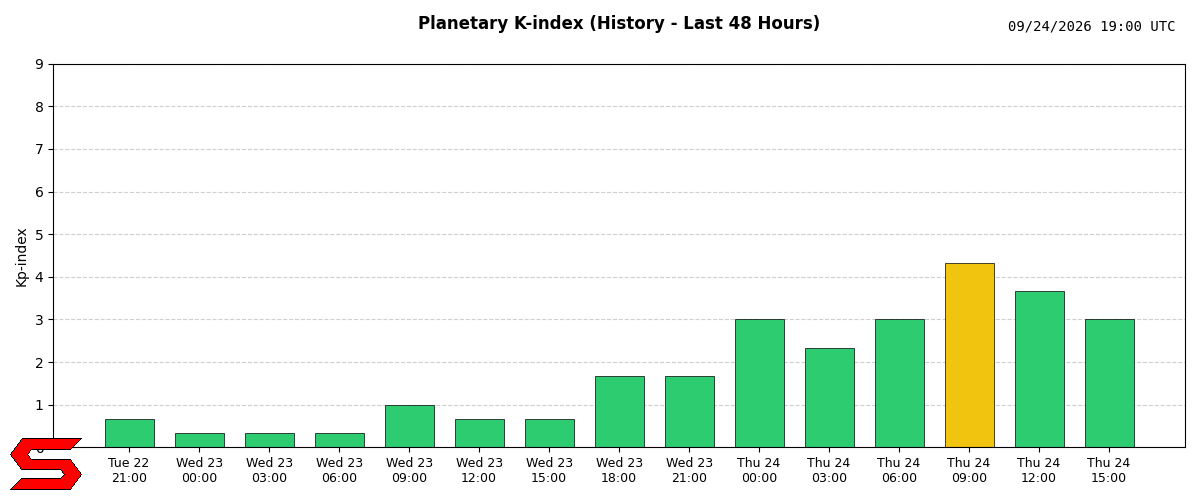
KP-Index :: Past 3 days
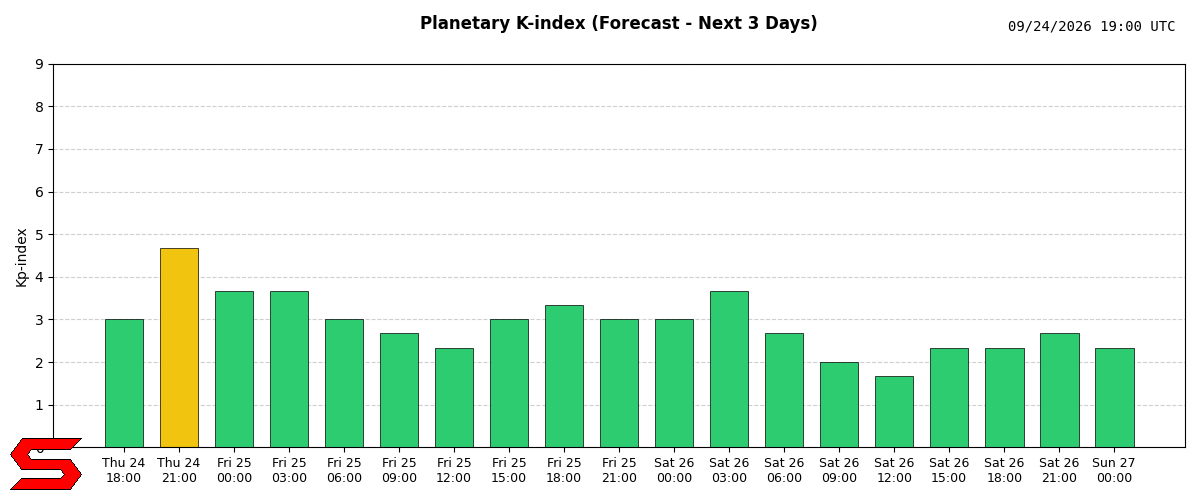
The Kp-index measures geomagnetic activity caused by solar particles interacting with Earth’s magnetic field. It directly affects the ionosphere, which is crucial for HF (high-frequency) radio propagation. Understanding the Kp-index helps operators predict which bands will work best and when interference is likely.
- Low Kp (0–2): Calm geomagnetic conditions. HF propagation is stable, long-distance contacts are reliable, and signals are strong.
- Moderate Kp (3–4): Minor disturbances. Some HF paths, especially on higher bands (15–10 m), may become unstable. Signals may fade or fluctuate.
- High Kp (≥5): Geomagnetic storms. HF signals can fade, disappear, or become very unstable. Lower HF bands (160–80 m) may sometimes improve due to ionospheric absorption effects. Aurora activity can cause unusual signal paths, but signals are often fluttery or distorted.
Practical tips for HAM radio and shortwave listeners:
- Monitor the Kp-index regularly to plan HF operation.
- Expect longer delays, signal fading, and unpredictable paths during Kp ≥ 5.
- Use lower bands during geomagnetic storms for more reliable communication.
- Aurora zones can provide unusual propagation paths, which may be interesting but challenging.
In short: A higher Kp-index usually means more HF interference and less reliable long-distance contacts, while lower values favor stable, high-quality communication.
KP-Index :: Forecast